Caffeinated Bitstream

Bits, bytes, and words.

The lost art of threaded discussions

While catching up on a mailing list recently, I was reminded yet again of my ongoing annoyance with the structure of online discussions. Many online forums and comment pages show posts one after another, in the order they were posted. This sort of linear structure (or lack of structure) becomes unwieldy for any but the smallest discussions. The author of a post may have introduced a new and interesting angle to the discussion, but you still have to wade through page after page of postings to see if there are any replies specifically directed to his post. (Here's a random example of a linear discussion forum -- 15 pages of one post after another!)


Science fiction writers have always speculated about the future -- sometimes they are quite accurate (Jules Verne predicted live newscasts, space travel, and the Internet in the 19th century) and other times not so much (flying cars haven't taken off yet). Authors typically set their science fiction stories well into the future, so they can get in a few good years of sales before the future becomes the present and their works begin to look naïve and obsolete. Far-future settings also allow an author to solicit a greater suspension of disbelief from the reader -- sure, warp drives and holodecks sound fanciful, but who's to say what wonders may be common in 400 years? However, occasionally authors will accept the difficult challenge of setting their stories in a near-future world similar to our own, where predictions about technological advancement must be grounded in reality and "science as magic" hand waving is not tolerated. It is these stories, when written by authors with expertise in the subject matter and the willingness to conduct research, that provide invaluable inspiration to those of us in the business of turning imagination into reality.


Western Design Center - Mesa, Arizona

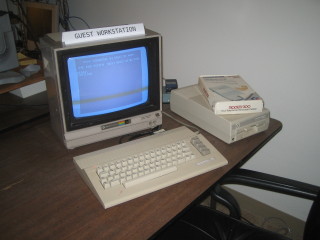
I'm traveling in Arizona at the moment, and decided to get in a bit of geek tourism by swinging by the Western Design Center (wikipedia) in Mesa, Arizona. The Western Design Center was founded by Bill Mensch, one of the creators of the MOS Technology 6502 series of microprocessors found in many personal computers of the 1980's, including the Commodore 64 and the Apple II. The 6502 series is somewhat nostalgic for me, as I taught myself machine language programming on the 6502 as a kid.


This advanced system can be used to arrange words and make edits without the need for white-out.

When I was growing up back in the 1980's, I wrote a lot of documents on my Commodore 64 including school assignments, letters, journals, and attempts at fiction. I used several different word processors during this time, but towards the end I was mostly using a product called Word Writer 4 from Timeworks. Now that I'm older, I'd like to preserve these childhood memories by converting them into a more modern, standardized format that can be easily viewed on modern computers. (You may find this shocking, but it turns out that contemporary word processors lack the ability to import from Commodore 64 file formats.)


Enthalpy of Application

Warning: The following post may contain weak metaphors and bad analogies. If these are offensive to you or illegal in your jurisdiction, you may want to skip this post.

Like many people who grew up in the forward thinking, happy go-lucky days of the twentieth century when anything seemed possible, I sometimes wonder what happened to all the futuristic luxuries that technology was supposed to have delivered by now. Science fiction promised us flying cars, ray guns, personal robots, and space colonies. I can understand speculative fiction not living up to reality -- after all, nobody has a crystal ball. However, many of us who were involved in software during the early to mid-nineties had some very specific and realistic notions of how computing technology would progress over the coming years, including the following:


I occasionally need to login to embedded Linux devices over serial connections. One frustrating thing about using a serial login is that programs running on the remote device don't know the window size of my local terminal emulator, so 80x24 is usually assumed even if I've resized my xterm to be much bigger (or even full screen!). Most network remote login protocols, such as ssh and telnet, use protocol features to communicate window change events transparently. Unfortunately, there is no such facility for serial logins, because there is no protocol.


Amazon Kindle: The Review

Prologue

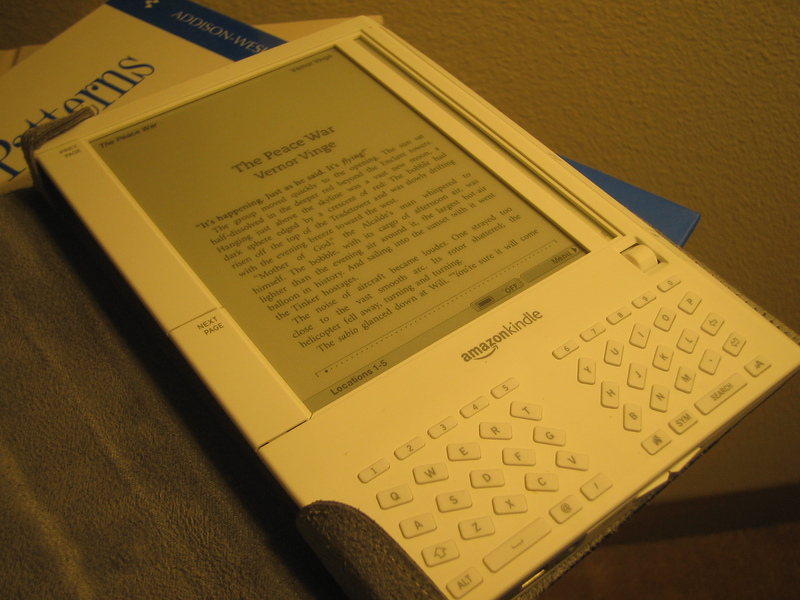
I broke down and bought a Kindle, the electronic book reader designed and sold by Amazon. I was somewhat interested in this device when it launched back in November, but Amazon sold out in five hours. Whether that's because of exceptional demand, or because Amazon only made eight, we'll never know. As a voting member of this year's World Science Fiction Convention, I recently received several books in electronic format for me to read and consider for the Hugo Award. (I tell people that I get to be a "superdelegate" for the big convention in Denver this fall.) As I spend way too many hours in front of a computer screen as it is, I figured this was as good an excuse as any to spring for an ebook reader. (Well, that, and an incurable love of gadgets.) It just so happened that Amazon had finally restocked the Kindle when I checked the web site on April 19th, so I decided to place the order. I selected the free two-day shipping, and my Kindle arrived a few days later.


New mail notifications on IM

For various reasons, I'd like to get a summary of new mail in my IM client. Since I use a traditional mail server with procmail support, and also operate a Jabber (XMPP) IM server, I decided to whip up a small python script to accomplish this. I used a Python XMPP library called xmpppy.

For what it's worth, I use the excellent Openfire Jabber/XMPP server software from folks at Jive Software. It's dead simple to install and configure, and a refreshing change from the bad old days of hacking away at jabberd. The basic version is free and open source, and Jive has recently announced that the enterprise version (which includes advanced features like reporting and logging) will become free and open source later this month.


Foreign Key Constraint Discovery

When developing database-oriented business webapps, the data model can sometimes become quite complex with many database tables referencing other database tables. To maintain referential integrity, you can (and should) declare foreign key constraints so rows cannot be deleted if other rows depend on them. However, if the application is a basic CRUD webapp that provides the user a direct, non-abstract view of the data, the user may be surprised to get a confusing constraint violation error when he or she attempts to delete a row. Such errors seldom contain useful details, so even if you wrap the error in a pretty page, the user may still be left wondering exactly why that row could not be deleted. Even if your database provides such details when a constraint is violated, an important usability question must still be asked: Why was the user given the option to delete the row in the first place, if deleting the row would result in a constraint violation?


Taming Roller's URL strategy

When I decided to start this blog, I installed the Roller 4.0 weblog software. Many different blogs can run in one instance of Roller, and the URLs for the blogs are arranged as subdirectories of a master Roller URL. For instance, if you installed Roller to be /roller, then your blogs might have URLs like /roller/my_blog, /roller/potato_farming_in_pocatello, and /roller/i_like_lettuce. That's fine for many uses, but I prefer to have more concise URLs. I'd like my blog to be referenced from the root of the web site, like /my_blog. Why should I have to conform to how Roller thinks I should set up my web site?